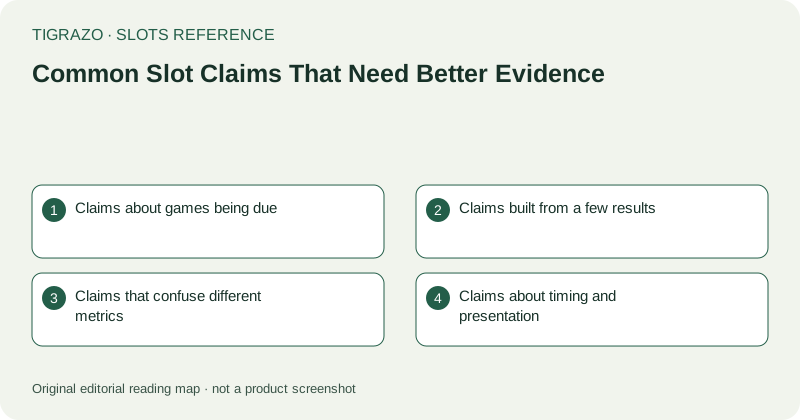
Claims about games being due
A statement that a slot is due to pay usually relies on recent losses or a long gap between features. For independent ordinary spins, that history does not establish a higher probability on the next spin. A genuine state-dependent mechanic needs a published rule describing the state and its effect. A streak, an animation or an observer's confidence is not a substitute for that rule.
Claims built from a few results
A small collection of wins cannot establish a game's RTP or typical session experience. The sample may be selective, the stakes may differ, and rare outcomes may dominate the total. Even a complete short record remains uncertain evidence about a long-run expectation. Ask whether the claim describes the recorded sample only or improperly generalises from it to everyone else's future results.
Claims that confuse different metrics
A high maximum award does not prove a high expected return. Frequent awards do not necessarily mean frequent net profits, because awards can be smaller than stakes. A volatility label does not specify feature frequency. When a claim jumps between these concepts, identify the exact metric being discussed. A precise definition often reveals that the evidence supports a narrower statement than the headline suggests.
Claims about timing and presentation
Suggestions that a particular hour, sound setting or stopping animation improves independent outcomes require evidence of an actual rule or documented mechanism. Interface choices can affect comfort and clarity without changing probabilities. Similarly, a near miss is a displayed non-winning result, not proof that a larger award is approaching. Distinguish a presentation observation from a mathematical statement about the next outcome.
Use an evidence ladder
- Write the claim in a form that could be checked.
- Identify the relevant game version and mode.
- Separate published mechanics from interpretations.
- Check sample size, selection and measurement units.
- State what remains unknown.
For example, the hypothetical statement that a feature appeared three times in one hundred observed rounds describes that record. It does not by itself establish a universal three-percent trigger rate. Missing observations, changing configurations and ordinary sampling variation all matter.
Better evidence does not always produce a dramatic answer. Sometimes the accurate conclusion is that a frequency is unpublished or a comparison cannot be made on the available information. That conclusion is more useful than replacing uncertainty with a confident story that could encourage additional spending.
A screenshot can prove that a message was displayed, but not that its implied general claim is true. Preserve that distinction when assessing evidence. Interface text, recorded outcomes and mathematical documentation answer different questions and should not be treated as interchangeable proof.