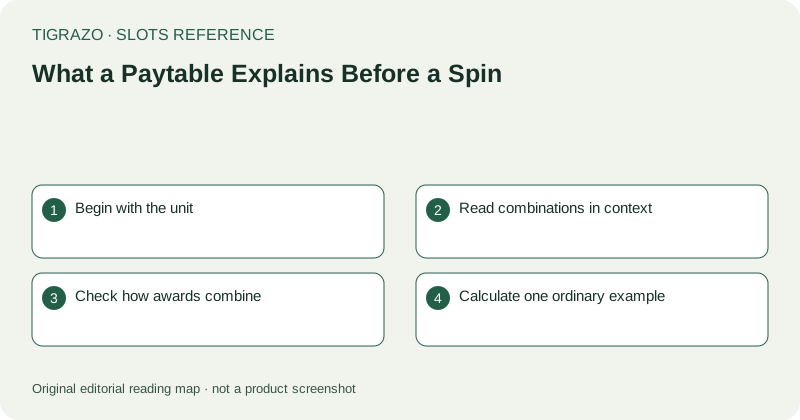
Begin with the unit
Before comparing numbers, establish what those numbers mean. A value may represent credits, a multiple of total stake, or a multiple of the stake assigned to one line. Currency displays can obscure that distinction. A change in denomination may also change how credits translate into money. Read the accompanying labels before calculating an example, and keep the same unit throughout the calculation.
Read combinations in context
Symbol count is only one condition. A paytable may require consecutive reels beginning on the left, a qualifying active line, or a connected group of a minimum size. Three matching symbols scattered across the display may therefore mean nothing under one evaluation method and qualify under another. Look for diagrams or wording that establish adjacency, direction and the starting position of a winning combination.
Check how awards combine
Some rules award only the highest qualifying result on each line. Others evaluate multiple ways or clusters separately. A scatter award may be added to ordinary wins, while another special result may replace them. A hypothetical line showing five identical symbols should not automatically be counted again as separate three-symbol and four-symbol wins. The combination rule determines whether those smaller patterns are included or excluded.
Calculate one ordinary example
In a hypothetical game, suppose the total stake is three units and a qualifying combination awards eight times total stake. The gross award is twenty-four units. Relative to the three-unit stake, that result increases the balance by twenty-one units if no other transaction applies. This distinction matters: the displayed award and the net change are not necessarily the same number. The example explains accounting, not the likelihood of that result.
Read beyond the symbol chart
Feature sections should explain trigger requirements, retriggers, substitutions and any limit on awards. Also inspect what happens when a maximum is reached: a feature may end immediately rather than continue through every remaining animation. Where rules are unclear, preserve the wording and ask for clarification before relying on an interpretation. A promotional summary is not an adequate substitute for these details.
- Confirm the current game version.
- Match the displayed stake to the paytable unit.
- Read exclusions for special symbols.
- Check which simultaneous results are payable.
A paytable does not normally reveal enough information to reconstruct every probability. Knowing an award amount is not the same as knowing its frequency.
Check whether the paytable changes when the stake or mode changes. A chart captured at one setting may not explain another setting. Preserve the selected values with any example so that a later reader can reproduce the same interpretation without guessing.