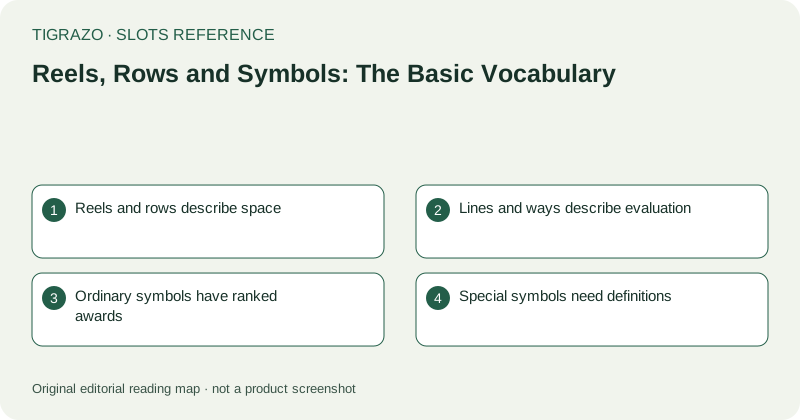
Reels and rows describe space
Reels are usually the vertical columns of a slot display. Rows are the horizontal levels visible across those columns. A position is one visible location where a symbol can appear. In a hypothetical five-reel layout with four visible rows, there are twenty positions. That is a description of the screen, not a claim that there are twenty chances to win or twenty separate wagers.
Lines and ways describe evaluation
A payline is a defined route across symbol positions. It can be straight, angled or otherwise specified in the rules. A ways-based game generally evaluates qualifying symbols on consecutive reels without requiring a particular drawn route, although its exact method still needs checking. The number of ways may vary with reel height. Neither a larger line count nor a larger ways count independently establishes a higher expected return.
Ordinary symbols have ranked awards
Ordinary symbols typically belong to an award schedule, with different amounts for different matching counts. Labels such as low-paying and premium refer to their relative awards under the relevant rules. They do not necessarily describe how often each symbol appears. An illustrated character may be visually prominent without having a unique mathematical role. Use the paytable to connect artwork with function rather than inferring importance from design.
Special symbols need definitions
A wild often substitutes for some ordinary symbols, but its exclusions matter. A scatter may pay anywhere, trigger a feature, or do both, subject to specific requirements. A bonus symbol may only count on certain reels. The same label can cover several behaviours across different games. Even two wild symbols within one game may have different movement, multiplier or persistence rules.
Use a vocabulary map
- Layout
- Reels, rows and positions describe where symbols appear.
- Evaluation
- Lines, ways and clusters describe how qualifying arrangements are counted.
- Function
- Ordinary, wild and scatter labels describe what symbols do.
When a description mixes these categories, rewrite it mentally as three separate statements. For example, a five-reel game might use cluster evaluation and include substituting wilds. None of those facts establishes the other two. This separation also helps expose missing information: a description that lists reels and special symbols may still omit the central rule for earning an ordinary award.
Precise terms make comparison easier, but they are not performance ratings. They explain the structure of play, not what any individual sequence of results will produce.
Credits deserve a separate vocabulary check. They are accounting units whose currency value depends on denomination. A credit award and a currency award can look similar on screen while representing different amounts, so always retain the unit when copying a number.