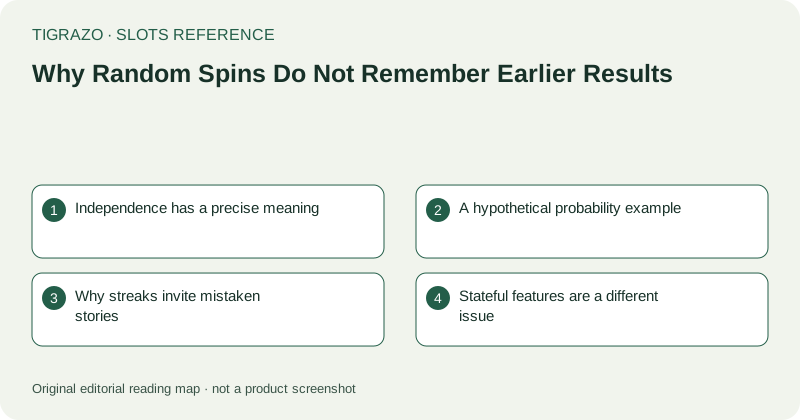
Independence has a precise meaning
Independent outcomes do not change one another's probabilities. If a particular result has a given probability on an ordinary spin under fixed rules, observing earlier outcomes does not raise or lower that probability. This is a statement about the process, not a claim that short sequences look balanced. Random sequences can contain long gaps, repeated outcomes and clusters that appear meaningful when viewed after the fact.
A hypothetical probability example
Suppose a hypothetical event has a one-in-ten probability on each independent trial. After nine trials without that event, its probability on trial ten remains one in ten. The earlier misses do not create a debt. The probability of ten consecutive misses is 0.9 multiplied by itself ten times, approximately 34.87 percent. Even this simple model produces extended gaps quite often; it does not describe any particular slot.
Why streaks invite mistaken stories
People tend to expect small samples to resemble long-run averages. When they do not, it is easy to invent a correcting force: a game is due, warming up, or paying back a prior loss. Those explanations confuse a description of the past with evidence about the next result. Changing a stake after a streak changes financial exposure, not an independent outcome's underlying probability.
Stateful features are a different issue
Some games retain an explicit state, such as a collected symbol, a changing multiplier or a position held during a feature. The next step can then depend on that recorded state according to published rules. This does not validate the claim that ordinary losing spins make an unrelated award due. Identify the actual state variable and the rule that changes it; do not infer hidden progress from animations or elapsed play.
A check for probability claims
- Does the claim concern an ordinary spin or a defined feature state?
- Is there a published rule connecting earlier results to the next step?
- Does the argument use only a recent streak as evidence?
- Is an average being presented as a deadline?
If the only supporting fact is that an outcome has not appeared recently, there is no established reason to treat it as more likely next. Recognising this limit is useful when deciding whether to stop: previous losses provide no mathematical obligation to continue. Session boundaries and spending limits can be set independently of any story about a result being overdue.
A record of past outcomes can still serve an accounting purpose. It helps reconcile stakes and awards, even when it has no predictive value. Keeping those two uses separate prevents useful round history from becoming the basis for an unsupported timing strategy.