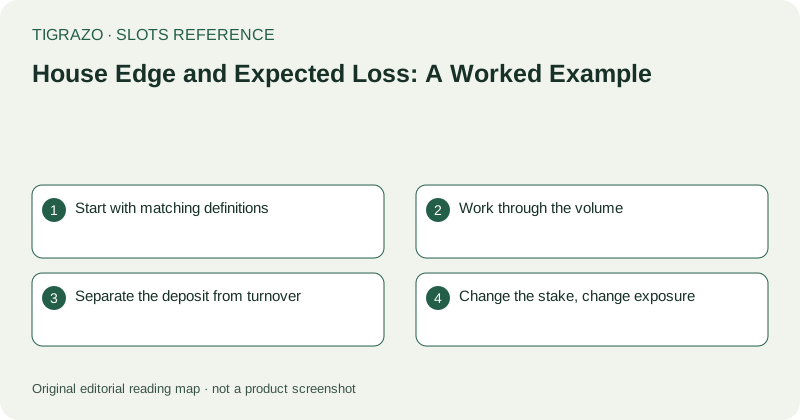
Start with matching definitions
For a game whose stated RTP includes the relevant awards, house edge equals one hundred percent minus RTP. A hypothetical RTP of 95 percent therefore corresponds to a 5 percent house edge. This relationship assumes the same game configuration and wager basis throughout. Do not combine an RTP for one mode with stakes from another, or ignore optional components whose mathematical treatment is described separately.
Work through the volume
Suppose a hypothetical sequence contains two hundred rounds at a stake of 0.50 units each. Total wager volume is one hundred units. With a 5 percent house edge, expected loss is one hundred multiplied by 0.05, which equals five units. Expected gross awards are ninety-five units. These are averages implied by the model, not a report of what those two hundred rounds actually returned.
Separate the deposit from turnover
The player need not deposit one hundred units to create that wager volume. Awards can be wagered again, allowing the same balance to support repeated stakes. Conversely, a balance can be exhausted before a planned number of rounds is completed. Expected-loss calculations based on a fixed volume describe that volume only; they do not guarantee the funds necessary to reach it or model every possible stopping rule.
Change the stake, change exposure
In the same hypothetical game, two hundred rounds at one unit create two hundred units of wager volume and ten units of expected loss. Doubling the stake doubles these amounts while leaving the percentage unchanged. A larger stake does not improve the expectation merely because awards are also larger in currency terms. Where rules change at different stake levels, that separate issue requires its own documented calculation.
Use the result for understanding
Realised loss is what actually happened: stakes minus gross awards for the recorded period. It can differ sharply from expected loss and can even be negative when awards exceed stakes. Expected loss does not describe a maximum loss, an amount that must be lost, or an allowance that resets after a win. It should not be used as a reason to keep wagering until actual results match an average.
- Confirm the applicable RTP.
- Calculate cumulative stakes in consistent units.
- Multiply volume by the complementary percentage.
- Label the result as hypothetical expectation.
That final label prevents a useful arithmetic example from being mistaken for a personal forecast.
Keep fees and unrelated wallet transactions outside the game calculation unless the question explicitly includes them. A withdrawal charge, for example, changes overall account cost but does not become part of a slot's house edge merely because both affect the same balance.