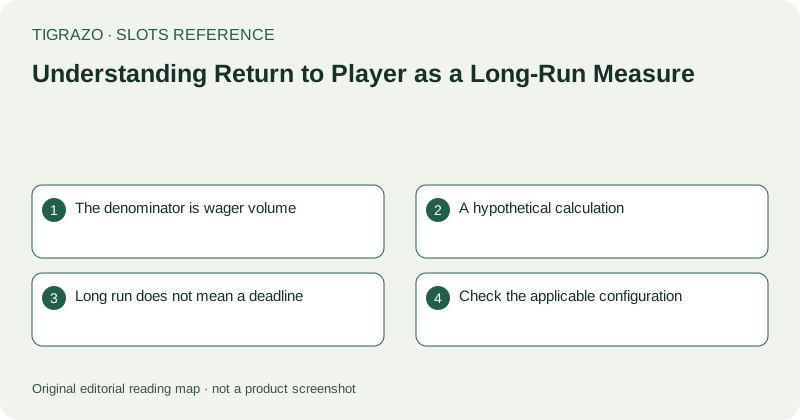
The denominator is wager volume
RTP compares expected gross awards with the total amount staked. Deposits are not the denominator. If funds are repeatedly wagered, wager volume can greatly exceed the initial deposit. A player might deposit twenty units and place one hundred units of cumulative stakes by reusing awards. The distinction is essential when interpreting percentages, because applying an RTP figure directly to a deposit answers a different and generally inappropriate question.
A hypothetical calculation
For a hypothetical game with a 96 percent RTP, one thousand units of wager volume correspond to 960 units of expected gross awards and forty units of expected loss. These are mathematical expectations, not required outcomes. An actual sequence can return much less or much more. The calculation also does not establish how many spins are needed for a player's results to approach the published percentage.
Long run does not mean a deadline
A published RTP arises from the game's probability model and award structure. It does not promise that a shortfall will be corrected within a particular number of rounds. Large, uncommon awards can contribute substantially to the average, leaving many short sessions far from it. Continuing to play after losses adds exposure to further outcomes; it does not turn the expected return into an amount owed to that player.
Check the applicable configuration
A title can have more than one published RTP configuration. A percentage found in a general description may therefore differ from the figure shown in the loaded game's information. Feature choices or optional stake components can also have separate conditions. Match the number to the actual version and relevant mode before interpreting it. Where a component is not included, do not silently treat the percentage as covering it.
Keep related concepts separate
RTP does not tell you hit frequency, the probability of finishing a session ahead, or the distribution of award sizes. Two hypothetical games can share the same expected return while delivering it through very different combinations of frequent small awards and rare large ones. Volatility concerns that distribution, while hit frequency concerns the occurrence of qualifying awards under its stated definition.
- Read RTP as a long-run expectation over stakes.
- Keep gross awards separate from net results.
- Confirm the version and included components.
- Do not use the percentage as a recovery target.
The useful conclusion is modest: RTP helps explain a game's mathematical cost structure, but it cannot specify an individual experience.
Observed return is a separate descriptive statistic. Dividing recorded gross awards by recorded stakes tells you the return in that particular sample. It should be labelled with its sample boundaries, rather than presented as a replacement estimate for the game's published model.