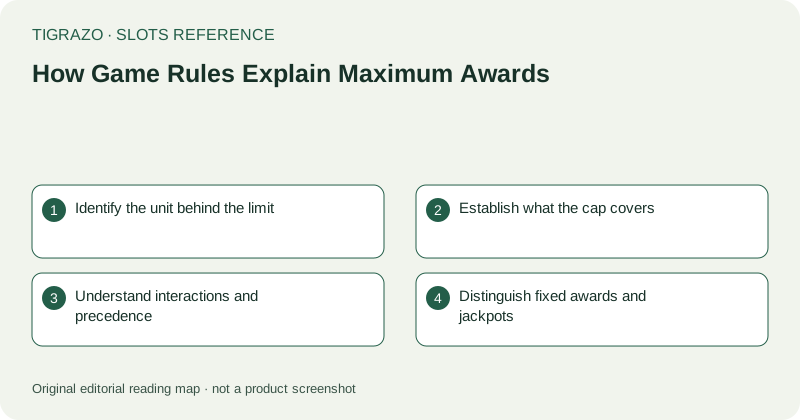
Identify the unit behind the limit
A maximum may be expressed as a currency amount, a number of credits or a multiple of total stake. Those forms are not interchangeable without conversion. In a hypothetical game, a cap of five thousand times total stake would equal ten thousand units at a two-unit stake, assuming the rules apply proportionally and no separate currency cap intervenes. This explains the ceiling, not its probability.
Establish what the cap covers
The limit may apply to a single spin, an entire feature, or an accumulated sequence that the rules treat as one round. A statement about the ordinary game may not include a separately described jackpot. Conversely, a headline maximum may already include every relevant component. Read the scope explicitly instead of adding the largest number from each information panel and assuming they can all be received together.
Understand interactions and precedence
Multipliers, collected awards and extra rounds can interact with a maximum-win rule. The cap may take precedence over a calculation that would otherwise produce a larger sum. Rules may also specify that reaching the limit ends the feature immediately. In that case, remaining displayed rounds are not necessarily played out. A visual counter does not override a written condition explaining how the round terminates.
Distinguish fixed awards and jackpots
A fixed jackpot amount can still require particular symbols, qualifying stakes or a designated feature state. The word fixed describes its amount or structure, not universal eligibility. A progressive amount may change over time and have separate contribution and reset rules. Neither type should be included in an assumed maximum without checking whether the published limit incorporates it and what conditions govern participation.
A practical reading sequence
- Copy the maximum statement with its units intact.
- Find the section defining its scope.
- Check stake-dependent eligibility and any currency ceiling.
- Read how the cap interacts with features and jackpots.
- Find the stopping and settlement conditions.
If two statements appear inconsistent, retain both rather than choosing the more attractive number. Version differences, abbreviated summaries or different wager components may explain the discrepancy. A precise question about the conflict is more useful than a general request for the biggest possible win.
Maximum-award information describes an extreme boundary. Without outcome probabilities, it does not establish expected return, feature frequency, volatility by itself, or the chance that an individual player will ever encounter that boundary.
Also distinguish a theoretical upper outcome from a contractual payout ceiling. They can coincide, but the wording may describe different constraints. A useful reference note preserves the original distinction instead of replacing both with an unexplained biggest-win number on a summary card.