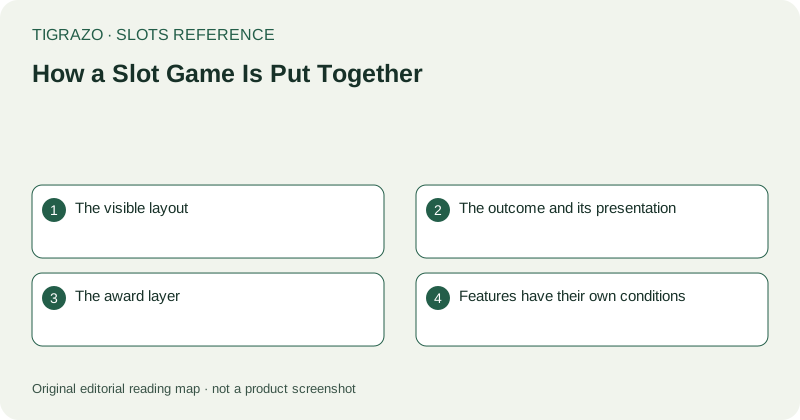
The visible layout
A reel is a vertical position or sequence used to display symbols. Rows determine how many symbol positions are visible at once. A five-reel, three-row display therefore shows fifteen positions, but that count alone does not establish the number of winning combinations. Some games evaluate lines, others use adjacent reels, and others count connected groups. Start with the evaluation rule rather than assuming that every visible arrangement can pay.
The outcome and its presentation
The system selects an outcome according to the game's mathematical rules, then presents it through animation. The apparent stopping sequence is not a useful guide to what will happen next. A symbol slowing near a winning position does not demonstrate that the next spin is more likely to succeed. Sound effects, celebrations and pauses belong to presentation; the rules determine the award associated with the completed result.
The award layer
A paytable connects specified outcomes with amounts or multipliers. It should also explain the relevant stake unit, qualifying symbol count and direction of evaluation. For a hypothetical example, an award of ten times a total stake of two units equals twenty units. If the displayed multiplier instead applies to a line stake, the calculation is different. Never transfer a multiplier between those units without checking its definition.
Features have their own conditions
Wild substitutions, scatter awards, extra rounds and changing reel layouts are additional rule systems. Their names do not fully describe their operation. A wild might substitute for ordinary symbols but exclude scatters. An extra round might use a different symbol set or reset a multiplier after each sequence. Features can interact, so reading their conditions together is more informative than treating each label as an isolated promise of a larger award.
A useful structural checklist
- Identify the visible layout and the method used to evaluate wins.
- Find the stake unit attached to each award.
- Check whether multiple awards can be combined.
- Read feature triggers, exclusions and ending conditions.
- Locate any published maximum-award rule.
This checklist describes how the game works, not whether a particular session will be profitable. Two slots can share a layout, theme and feature vocabulary while using different symbol probabilities and award distributions. Treat visual similarity as a browsing aid, and the version-specific rules as the authority for mechanics.
Another useful distinction is between a round and an evaluation. One paid round can include several evaluations during a feature or cascade. Counting every animation as a fresh paid spin would misdescribe both the process and the associated balance changes.